June 9, 2026
Canada’s National AI Strategy: Thoughts
AI Disclaimer: This blog piece is not AI generated. I have used NotebookLM to generate a beautiful infographic that summarizes the 50 page document visually on a single page.
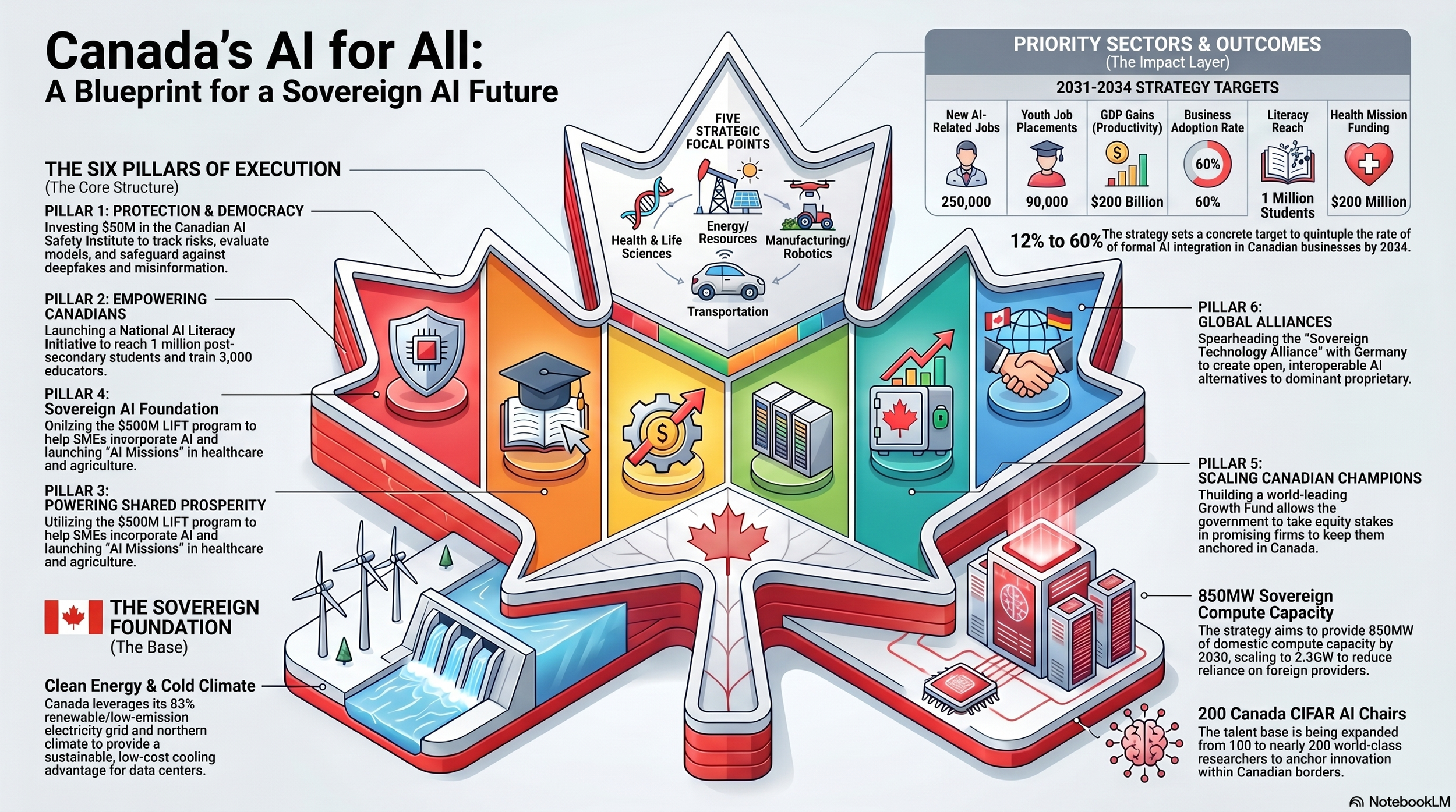
It was great to see Canada launch an Artificial Intelligence Strategy document. I read through this 50-page document, and my first impressions are that this is a great first step in recognizing the immense opportunities and the inflection point that we are at today. It also does not shy away from the impact it will have on various communities, the workforce, and the general Canadian population.
I was struck by some amazing insights that I got from reading the document. Here are a few snippets.
Canada ranks 42nd in a study across 47 countries in terms of AI literacy and usage.
Canada has been at the forefront of AI research. Nobel Laureate Geoffrey Hinton and Turing Award winners Yoshua Bengio & Richard Sutton are the three so-called godfathers of AI.
However, the gap between cutting-edge research and business adoption is huge. Only 12% of businesses use AI in Canada, compared to around 42% in the Nordic countries.
Canada has some strategic advantages. It has one of the world’s cleanest grids. 83% of its energy comes from renewables, hydro, and nuclear. Canada’s cold climate is actually a strategic advantage gifted by nature. The very cold climate makes the location of data centres a huge logistical advantage due to a far lower environmental footprint for cooling these data centres.
Canada has some trailblazers like Cohere, LawZero, and Croptimistic, whose technology is being used across farms around the globe. However, this is far behind the pace at which China and the US are growing.
So what are the salient features of the AI policy?
The 6-pillar strategy calls for some great actions:
Focusing on priority sectors that include Health & Life Sciences, Transportation, Robotics, and Agriculture. I believe this is the correct focus given the contribution of these sectors to Canadian GDP as well as their strategic importance to the national economy.
There is an emphasis on equipping Canadians with the tools and education to help them decide for themselves where they want to include AI in their work and lives. The fact that public libraries and schools will be equipped with the tools and education is the right step in ensuring that Canadians are not left behind.
Canada will use a Build-Partner-Buy approach. This strategy recognizes that Canada is lagging behind in certain aspects of AI, so it is best to build where the skills exist, partner to gain access to the latest technology, and buy where absolutely necessary. I love the idea of Canada going for its own supercomputer and the need to build its own compute capacity. There is recognition that a world-class communications network needs to be the backbone of this ecosystem.
The policy document has given the status of a strategic national asset to data. This is a key moment where Canadian policymakers realize the wealth they are sitting on. The document calls out the fact that, by having a universal healthcare system, there is a wealth of information that AI systems would benefit from consuming and using to generate useful models.
The Government wants to take stakes in AI companies and offer the necessary capital to avoid a flight to the South. By doing so, the Government gets skin in the game and also helps grow the ecosystem.
What do I feel needs to be added to this policy document?
The Government needs to give subsidized access to world-class LLMs to its entire population, with priority access for students and entrepreneurs. This would usher in a new era of high adoption and innovation.
For AI education, partner with world-class educators and pathfinders, not academically dense training programs that most of the general public would find difficult to consume.
The Build-Partner-Buy approach is the right strategy. However, there are only two countries in the world with leading models: China and the US. Pick your partners and then focus on knowledge-transfer initiatives that lead to self-reliance.
Appoint industry champions who are incentivized to get more and more of their peers to adopt the same technology and reap the benefits.
Make Canadians equal partners in reaping the benefits by allowing them to have equity stakes in Canadian AI companies. Let AI create equity rather than disparity.
Read the entire strategy document here: https://ised-isde.canada.ca/site/ised/en/canadas-national-artificial-intelligence-strategy-ai-all